An introduction to a simple tool with a long history and a place in modern spiritual practice
There is something rather fascinating about a pendulum. A small weighted object suspended from a chain or cord, gently moving in response to the slightest movement of our hand. Such a simple instrument, yet one that has captured human curiosity for generations. Pendulums have found their way into many different practices, from traditional dowsing to contemporary energy work, divination, and spiritual exploration. For some, they offer a way to explore intuitive impressions. For others, they become familiar companions in meditation, reflection, or personal spiritual practice.
I’ve worked with pendulums for many years, particularly in my teaching and exploration of the chakras and the human energy system. Although I don’t reach for one every day, my pendulum remains a trusted resource, something I return to when I feel drawn to work with it. What I especially appreciate about the pendulum is how working with one can encourage us to become more familiar with our intuition, our expectations, and the subtle ways we experience information.
A Little History of the Pendulum
The pendulum belongs to a broader family of practices commonly known as dowsing or divination. Historically, dowsing has been associated with attempts to locate underground water, minerals, and other hidden resources. Different instruments have been used for this purpose, including forked branches, rods, and suspended weights. Over time, pendulums also became associated with spiritual inquiry, intuitive exploration, and various forms of energy work. Today, they are used in many different ways, depending on the beliefs, interests, and experiences of the person holding them.
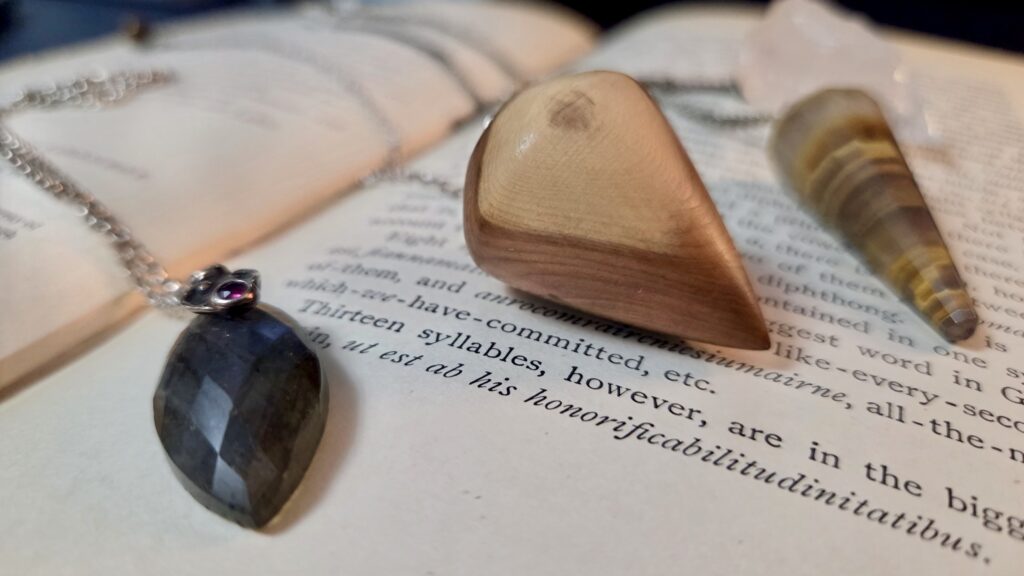
A pendulum itself can be made from almost anything that provides a little weight at the end of a string or chain. Crystals and gemstones are popular, but pendulums may also be made from wood, metal, glass, or other materials.
My personal preference is a pendulum made from wood, particularly English Yew. As a Weaver, I have a deep appreciation for the relationship between trees, their symbolism, and the ways we incorporate them into our spiritual practices. Yew has a rich place in the folklore of the British Isles, often associated with longevity, continuity, and the mysteries of life and death. It is also among the trees associated with Ogham in later medieval and modern tree traditions. I also have a trusted Tiger’s Eye pendulum that I’ve worked with for years, particularly in my teaching and sessions with students and clients. Both have their own place in my practice, and I enjoy the different qualities they bring to my work.
Choosing Your Pendulum
Choosing a pendulum can be a wonderful first step in exploring your intuition. When looking at different pendulums, I encourage you to notice which one you’re immediately drawn to. Perhaps it’s the color of a particular gemstone, the texture of polished wood, or simply the way a pendulum feels when you hold it. You might be attracted to its energy, experience an emotional connection, or find that its material or appearance reminds you of a meaningful person, place, or memory. Sometimes there’s no particular reason you can identify. One pendulum simply catches your attention, and you find yourself returning to it. You don’t necessarily need to purchase a pendulum to begin exploring. A favorite necklace with a pendant can work beautifully, provided it hangs freely from its chain or cord. It might even be a piece of jewelry that holds special meaning for you, adding another personal connection to the experience.
There is no right or wrong way to choose a pendulum, and you don’t need to understand the spiritual properties associated with every crystal, stone, or type of wood before making your selection. Allow yourself to enjoy the experience and trust what naturally appeals to you. If several pendulums catch your eye, take your time exploring them. Notice how each feels in your hand and which one you find yourself wanting to work with. Most importantly, be confident in your choice. The pendulum that resonates with you doesn’t have to be the one someone else would choose, and that’s part of what makes the relationship with your pendulum personal. Your exploration of intuition can begin with the simple pleasure of choosing something that feels right for you.
Developing a Relationship with Your Pendulum
One of the first things I teach beginners is how to become familiar with the movement of their pendulum. Many people use a simple system of yes, no, and maybe responses. These might be represented by a forward-and-backward swing, a side-to-side movement, or a clockwise or counterclockwise circle. In my teaching, I encourage students to establish these signals intentionally. This provides a consistent way to recognize and interpret the pendulum’s movement as they become familiar with the practice.
Over time, working with a pendulum may begin to feel quite natural. You become familiar with how it moves in your hand, how your attention influences your experience, and how you respond to the questions you’re exploring. It’s worth remembering that pendulum movement can arise through the ideomotor effect, in which tiny, unconscious muscle movements produce visible motion. This is one reason I encourage people to approach pendulum work as an intuitive and reflective practice rather than as a source of guaranteed answers. For me, this doesn’t take away from the enjoyment of working with a pendulum. It simply gives us another interesting dimension to consider as we explore the relationship between our awareness, expectations, and experience.
The Pendulum and Intuition
Intuition is something we often recognize through experience. We may have a feeling about a situation, notice an impression that catches our attention, or sense that something deserves a closer look. Learning to recognize these impressions can take time, especially when we’re accustomed to relying primarily on logical reasoning. A pendulum can provide an interesting way to explore that relationship. It gives us something tangible to work with while we consider a question, observe our responses, and become more aware of what we’re experiencing.
In my own energy work, I’ve often used a pendulum while teaching about the chakras. Within that spiritual framework, the pendulum offers a visual and experiential way to explore concepts associated with the human energy system. I also appreciate that a pendulum can become a familiar companion. Just as someone might enjoy working with tarot cards, Ogham staves, or another divination tool, a pendulum can become part of a personal practice that develops and changes over the years. The value isn’t necessarily in using it frequently. Sometimes it’s simply knowing that the tool is there when you wish to explore something through that particular practice.
Exploring Your First Pendulum
If you’ve never worked with a pendulum, you might enjoy beginning with a little experimentation. Find a comfortable place to sit and hold your pendulum by its chain or cord, allowing the weighted end to hang freely. Resting your elbow or forearm on a table may help you feel comfortable and steady. Take a moment to settle into the experience. You don’t need candles, music, or a special setting, although you’re welcome to include anything that makes the exploration enjoyable.
Begin by gently moving your pendulum forward and backward. Notice how the movement feels in your hand. Then try moving it from side to side, followed by a small circular motion. You might choose one movement to represent yes, another for no, and a third for maybe or uncertainty. Practice each movement until the signals feel familiar. Once you’re comfortable, try asking a simple question with an answer you already know, such as whether is my name [your name] or whether you’re holding a pendulum.
Notice what happens. Does the pendulum move as you expected? Does it take a little time to begin swinging? Are you aware of any subtle movements in your fingers or hand? There is no need to force an outcome. Sometimes the movement will be clear, and sometimes it won’t. Both experiences can be interesting. As you become more familiar with the practice, you may enjoy exploring questions that invite personal reflection. I particularly encourage beginners to consider how they phrase their questions and to remain curious about their own impressions.
A pendulum is not a substitute for reliable information, professional advice, or your own judgment. It can, however, be an enjoyable addition to a reflective or spiritual practice.
A Companion Along the Way
Over the years, I’ve come to appreciate that spiritual tools can serve different purposes at different times in our lives. Some become part of our everyday practices, while others are brought out occasionally. We may use them in teaching, meditation, personal exploration, or simply because we enjoy the experience of working with them. My pendulum has remained one of those familiar resources. It has accompanied my exploration of energy work and provided another way to engage with intuition and awareness.
Perhaps that’s part of what makes these simple tools so enduring. They invite curiosity, encourage experimentation, and offer opportunities to explore our relationship with the world and with ourselves. And sometimes, the beginning of that exploration is as simple as holding a pendulum in your hand and seeing what happens.
The Apothecary at Weaver Grove is a library of lived wisdom, where we explore the natural world, spiritual traditions, energy practices, and the mysteries of being human.
Interested in exploring further? Weaver Grove offers opportunities for individual spiritual mentoring and continued learning. You’re welcome to reach out if you’d enjoy exploring these practices together.