December 24 | Day Three of Yule
There are some ancient traditions whose meanings have become lost to time, leaving behind little more than a name and the curiosity it awakens. Mothers’ Night is one of those intriguing mysteries. When I first encountered it while exploring the older winter celebrations, I found myself wondering who these Mothers might have been and what it meant to honor them.
The more I considered the name, the more I began thinking about the women who have held a motherly place in our lives. Not only the women who gave birth to us, but those who have nurtured, guided, encouraged, and loved us along the way. Women whose presence has made a difference, sometimes in ways they may never fully realize.
And I began to wonder whether this ancient mystery might offer a beautiful opportunity to honor the many faces of motherhood in our lives today.
The Mystery of Mothers’ Night
Our earliest surviving written reference to Mothers’ Night comes from the eighth-century English monk and scholar Bede. In his account of the Anglo-Saxon calendar, he described an observance called Mōdraniht, meaning Mothers’ Night, associated with the night before December 25. He mentioned that ceremonies were held, but offered little explanation of what those ceremonies involved or whom they honored.
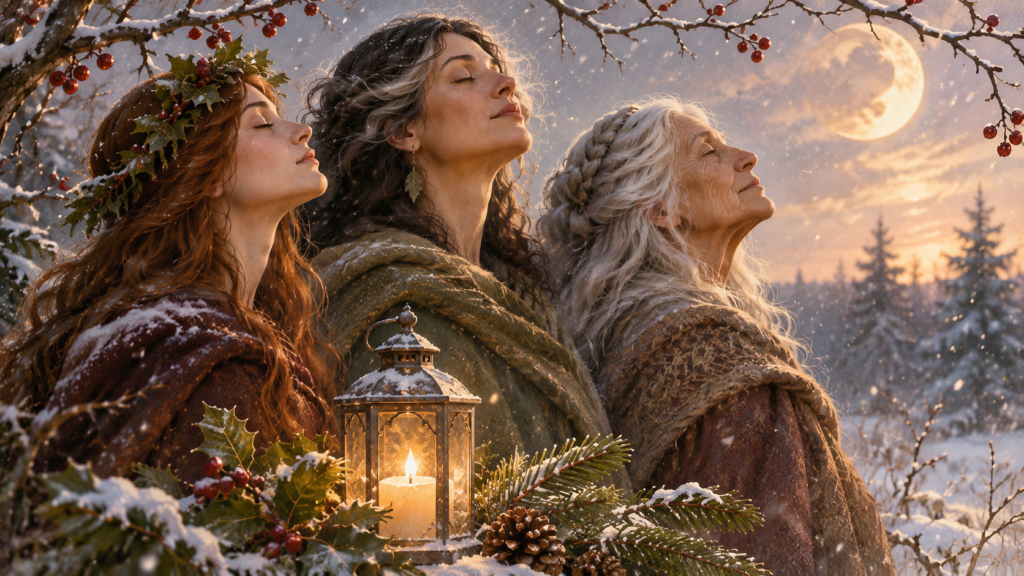
Scholars have suggested that the Mothers may have been ancestral women, protective female spirits, or divine figures associated with families and communities. There are intriguing parallels with the Matres and Matronae, mother divinities honored in parts of the Celtic and Germanic world during the Roman period. These figures were sometimes depicted in groups of three, often with symbols of abundance, and were associated with protection and well-being.
Whether these were the same Mothers remembered in the Anglo-Saxon observance remains unknown. The historical record leaves us with possibilities rather than certainty.
I find that mystery rather wonderful. We may never know precisely what Mothers’ Night meant to those who observed it centuries ago, but its name can still invite us to consider what honoring the Mothers might mean in our own lives.
The Women Who Mother Us
When we hear the word mother, we often think first of the woman who gave us life. For some, that relationship is one of the most cherished connections they will ever know. For others, it may be complicated, distant, or marked by absence and loss. Yet the experience of being nurtured by a woman is not always confined to that first relationship.
Throughout our lives, we may encounter women who offer something of a mother’s love. A grandmother who provides a place of comfort, an aunt who listens without judgment, a teacher who recognizes our potential, or a friend whose wisdom and encouragement help us find our way. Sometimes these women become part of our lives for many years, while others appear at a moment when their presence makes all the difference.
Their care does not need to replace the love of our own mothers, nor does it diminish those relationships. There is room in our lives for many meaningful connections, each offering something uniquely its own.
I’ve been fortunate to know women who have nurtured and guided me, and I treasure the influence they’ve had on my life. Their kindness, wisdom, and encouragement have become part of my own story, reminding me that the gifts of a motherly presence can reach far beyond the bonds of birth.
The Love We Offer in Return
I’ve also come to appreciate another side of this experience.
I chose not to have children of my own, yet over the years I’ve developed relationships in which I’ve found myself holding a motherly place in someone else’s life. These are connections I cherish deeply, with a love that feels much like the love I imagine having for a child of my own, while honoring the unique nature of each relationship.
Sometimes that means being present to listen, offer encouragement, or share a little wisdom. Other times, our lives may take us in different directions, and the connection is held quietly in the heart. We don’t always need to be part of someone’s everyday life to continue caring for them or wishing them well.
What matters to me is the love and connection itself. There is no need to take the place of another mother or define the relationship by traditional expectations. It is simply another way that a woman’s nurturing presence can become part of someone’s life.
And I think there is something worth celebrating in recognizing that motherhood can be experienced in ways that extend beyond giving birth or raising children. The capacity to offer a mother’s love is not limited to one particular path through life, nor is it an obligation placed upon women. It is a gift some choose to share, in relationships that develop naturally and hold meaning for those involved.
Honoring the Many Faces of Motherhood
As I reflect on Mothers’ Night, I find myself less concerned with discovering a definitive answer to its ancient mystery and more interested in the possibilities its name awakens. Who are the women who have offered us comfort, encouragement, wisdom, or protection? Who helped us discover our strength, welcomed us when we needed a place to belong, or simply loved us as we were? And where might we have offered those same gifts to someone else?
These connections may be woven through generations of family, through friendships that become family, or through unexpected relationships that touch our lives in lasting ways. Some of these women are still with us, while others live on in our memories and in the qualities they helped nurture within us.
Perhaps honoring the Mothers today can be as simple as recognizing the love that has moved through our lives, appreciating the women who have shared it, and acknowledging the connections we continue to cherish.
Ways to Celebrate Mothers’ Night
On this third day of Yule, I invite you to think of a woman who has held a motherly place in your life. She may be your own mother, a grandmother, a dear friend, a mentor, or someone whose kindness and wisdom arrived when you needed them most.
You might reach out to let her know what her presence has meant to you, share a memory, or enjoy a tradition that reminds you of her. If she is no longer with you, perhaps a photograph, a favorite recipe, a candle, or a quiet moment of remembrance would be a meaningful way to honor her.
You might also reflect on the people for whom you’ve held a nurturing place. Not as a measure of what you’ve done for others, but simply in appreciation of the connections that have enriched your life.
There is no particular ceremony we must follow, and no single way to experience this night. We can allow the mystery of Mothers’ Night to inspire a celebration that feels meaningful to us.
Something to Ponder
Who are the women who have offered me a mother’s love, and where have I had the opportunity to offer that same love to another?
The ancient meaning of Mothers’ Night may remain a mystery, but the love, wisdom, and nurturing presence of women are experiences many of us recognize in our own lives.
And on this winter night, I find something especially beautiful in honoring the Mothers—not only those who brought us into the world, but all those whose love has helped us find our place within it.